
Young County Sex Offender Checks
The Texas Public Sex Offender Registry is the main public source for a Young County registry check. Texas DPS operates the database under Code of Criminal Procedure Chapter 62. It gathers registration data reported by local law-enforcement authorities. A search can locate public entries tied to Young County, but it cannot prove where a person is at a given moment. Check the profile's dates and registering agency before drawing a conclusion.
Use the local authority as the second channel. The Young County Sheriff is generally responsible when a registrant lives outside a municipality. Inside Graham, the police chief is generally the local registration authority. The same rule points residents of other municipalities toward the appropriate police authority when one serves that location. Searchers should call the listed registering agency when a detail seems stale, unclear, or inconsistent.
Young County Registry Search Routes
A Young County search works best when the question is clear first. A name search helps confirm whether a known person has a public profile. A county filter surveys entries associated with Young County. An address search examines a set area, while list and map views can help a reader compare locations. Spelling and location data matter, and a common name can return more than one possible match.
The DPS registry interface shown here is the official state starting point.
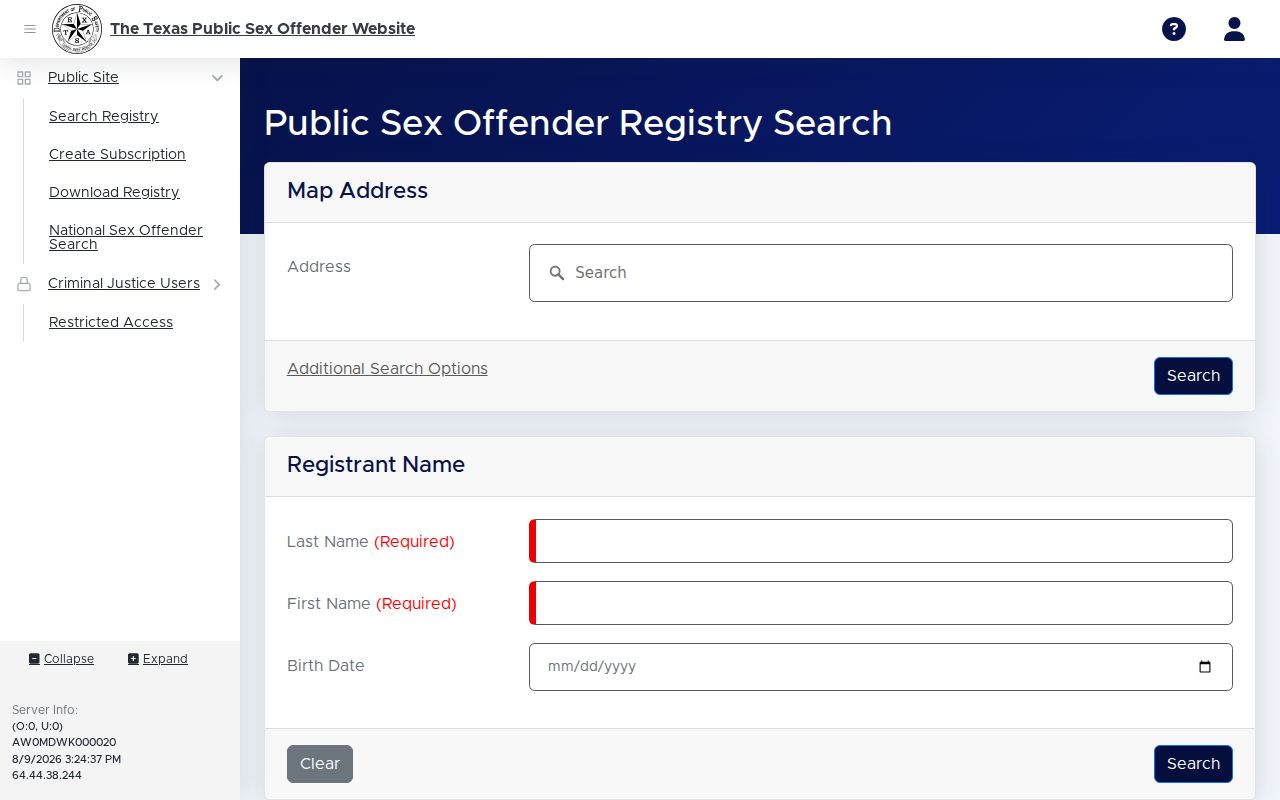
The screen illustrates why the search mode and identifying fields should be chosen before opening a result. It does not display or single out a private search subject.
Texas Public Sex Offender Registry Searches
DPS provides name and location routes rather than one universal query. Start broad enough to find a likely entry, then use the fields that can distinguish it. The county dropdown is useful for a Young County registry search, but the research did not establish that a blank county-only submission is always accepted. Current controls can change, so read the live form and its terms before submitting.
- Open the official DPS registry and read its accuracy and misuse notices.
- Choose a name or location search, then enter only the fields relevant to that mode.
- Set Young as the county when the live form permits it, or enter a city, ZIP code, or address for a local area search.
- Compare likely results by identifiers, open the full profile, and contact the registering authority when current status needs confirmation.
The form exposes the following controls documented in the Young County research.
| Field Label | Type | Required | Notes |
|---|---|---|---|
| Last Name | Text | Varies by mode | Primary field for a name search. |
| First Name | Text | Optional | Helps narrow people with the same last name. |
| Address, City, ZIP | Text | Address mode | Supports a location-based search. |
| County | Dropdown | Optional | Select Young for county scope when allowed. |
| Radius | Dropdown | Address mode | Read the live options because values may change. |
| Search or Clear | Buttons | Not applicable | Runs the chosen mode or resets its fields. |
Young County Address Search Choices
A county filter and an address-radius query do not answer the same question. The Young County filter is useful when the reader wants records connected with the county as a whole. An address search is better for a home, school route, park area, or another place important to a family safety plan. Map markers provide orientation, not proof of presence at that precise time.
Location fields also need context. A profile may show a residence address or a location description allowed by Chapter 62. Some public fields can include school, work, or volunteer locations when state law makes them available. No universal Young County residency-distance ordinance was verified in official local material. Do not infer a local boundary rule from a pin on the map or from rules used by another Texas county.
Note: Confirm any time-sensitive address concern with the registering law-enforcement authority instead of relying on a saved image or an old result.
Registry Profiles: What They Show
A public Texas registry profile combines identifying, registration, location, offense, vehicle, and compliance data. That mix helps a reader separate similar names and understand why an entry appears. The profile is still a specialized Chapter 62 record. It does not replace the Young County court file, the arresting agency report, or a DPS criminal-history record.
| Name and Aliases | Registered name, reported aliases, and a DPS or registry identifier. |
|---|---|
| Image and Description | Published current or prior photo, sex, race, age or birth data, height, weight, hair, eyes, scars, marks, and tattoos where shown. |
| Registered Location | Residence address or permitted location description, plus city, county, and ZIP information. |
| Offense Facts | Offense description or statute, adjudication or conviction date, jurisdiction, sentence, and lawful victim-category information. |
| Risk and Duty | Risk level, verification requirements, registration status, registering agency, and an end date when applicable. |
| Compliance and Vehicles | Compliant, noncompliant, or absconded indicators, last verification facts, and published vehicle details. |
Read the update and verification fields with the location data. A photo or address can lag after a lawful change, while an offense entry may remain public for the full registration term. For a Young County record that appears inconsistent, note the profile identifier and contact the agency listed as the registering authority.
Registration Levels and Duties in Texas
Texas publishes risk levels under Article 62.007. Level 1 describes a low danger assessment and a finding that continued criminal sexual conduct is not likely. Level 2 reflects moderate danger and a possibility of continued conduct. Level 3 reflects serious danger and an assessment that conduct will continue. These are risk findings, not federal SORNA tier labels.
Registration duration is a separate legal question under Article 62.101. A lifetime duty covers sexually violent and other listed offenses. A ten-year duty covers specified categories and runs from the event named by statute, such as release, discharge, dismissal, deferred discharge, or disposition. The registry profile and the current statute should be read together.
| Texas Concept | Meaning | Duration or Visibility |
|---|---|---|
| Level 1 | Statutory low-risk assessment | Risk level is public; it does not alone set duration. |
| Level 2 | Statutory moderate-risk assessment | Risk level is public; duty follows the offense rule. |
| Level 3 | Statutory high-risk assessment | Risk level is public; duty follows the offense rule. |
| Lifetime | Enumerated Article 62.101 offenses | Ends at death unless another statutory rule applies. |
| Ten years | Specified transferred juvenile and other reportable cases | Measured from the event set by Article 62.101. |
Young County Registry and NSOPW
The DPS registry is the best first tool for a Texas address and a Young County filter. The National Sex Offender Public Website adds a cross-state layer to a Young County search. NSOPW sends searches across participating jurisdiction systems, so it is useful when a person may have moved or when a safety check crosses a state line. It can time out apart from the Texas system.
The official national search screen below shows that broader route.
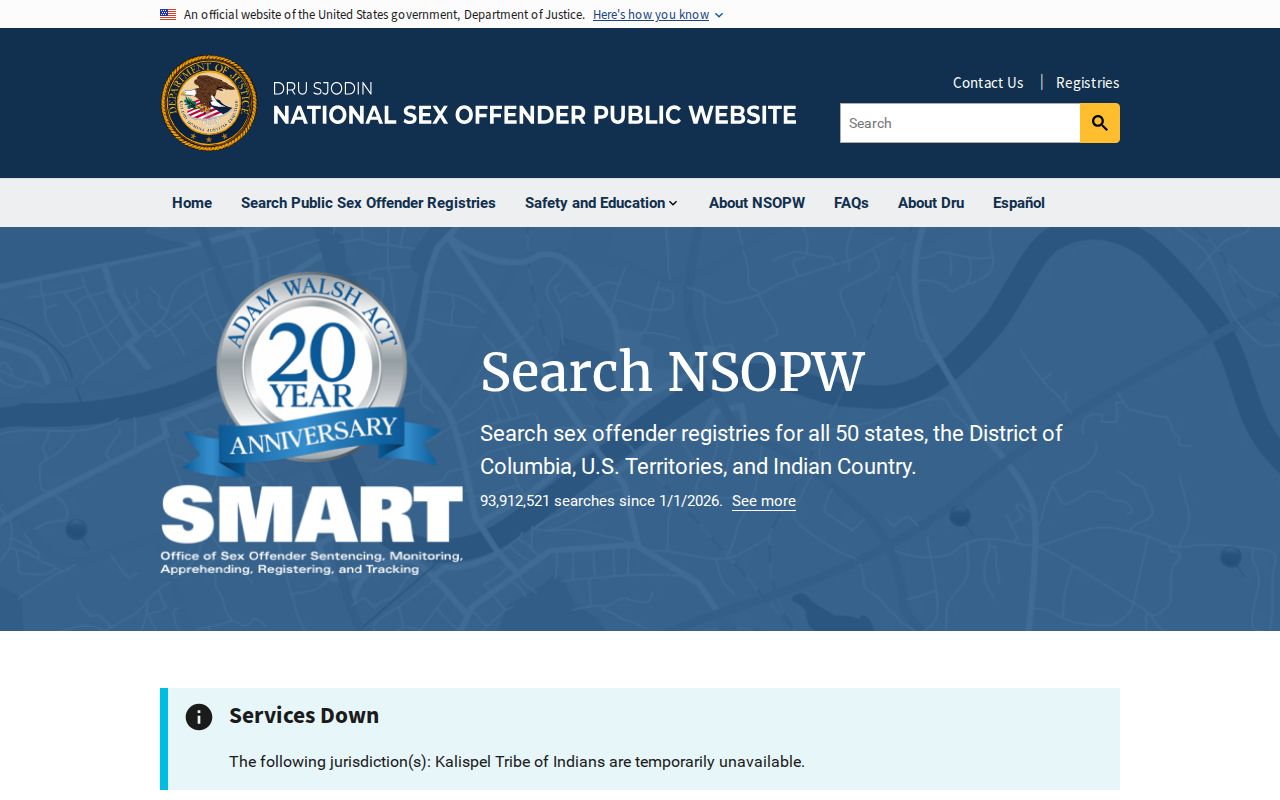
A national result should be opened through its source jurisdiction and checked against the local registering authority. NSOPW is a second layer, not a substitute for a current Young County confirmation.
Young County Noncompliance Reports
A Young County profile may carry a noncompliant or absconded indicator, but readers should not investigate a registrant themselves. Record the public profile identifier, the location concern, and the date the information was viewed. Report a suspected Young County failure to the registering agency shown on the profile. For an unincorporated Young County location, the sheriff is the practical first call. Graham concerns should be checked with Graham Police.
If an address merely looks old, ask whether the agency can confirm receipt of updated registration facts. The public may not be given confidential investigative steps. DPS and the local authority can compare the report with their own data. A registry flag is not a license to confront, follow, publish claims about, or threaten anyone.
Using Registry Information Lawfully
Young County registry records serve community awareness and personal or family safety planning. They should be read with care. A profile can change after a move, verification, correction, or new legal event. Texas law requires a misuse warning, and the registry itself carries public-safety and accuracy notices.
Misuse is prohibited: Article 62.064 of the Texas Code of Criminal Procedure warns against using registry information to injure, harass, or commit a crime against a registrant. Misuse may bring criminal or civil consequences.
Use an official Young County record to make a calm safety plan, not to encourage vigilantism. Confirm key facts with DPS or the Young County authority named in the record. Young County registry status does not describe every case in a person's past, and the absence of a public profile is not a certificate that no criminal record exists.